

Microsurgery
What is Microsurgery?
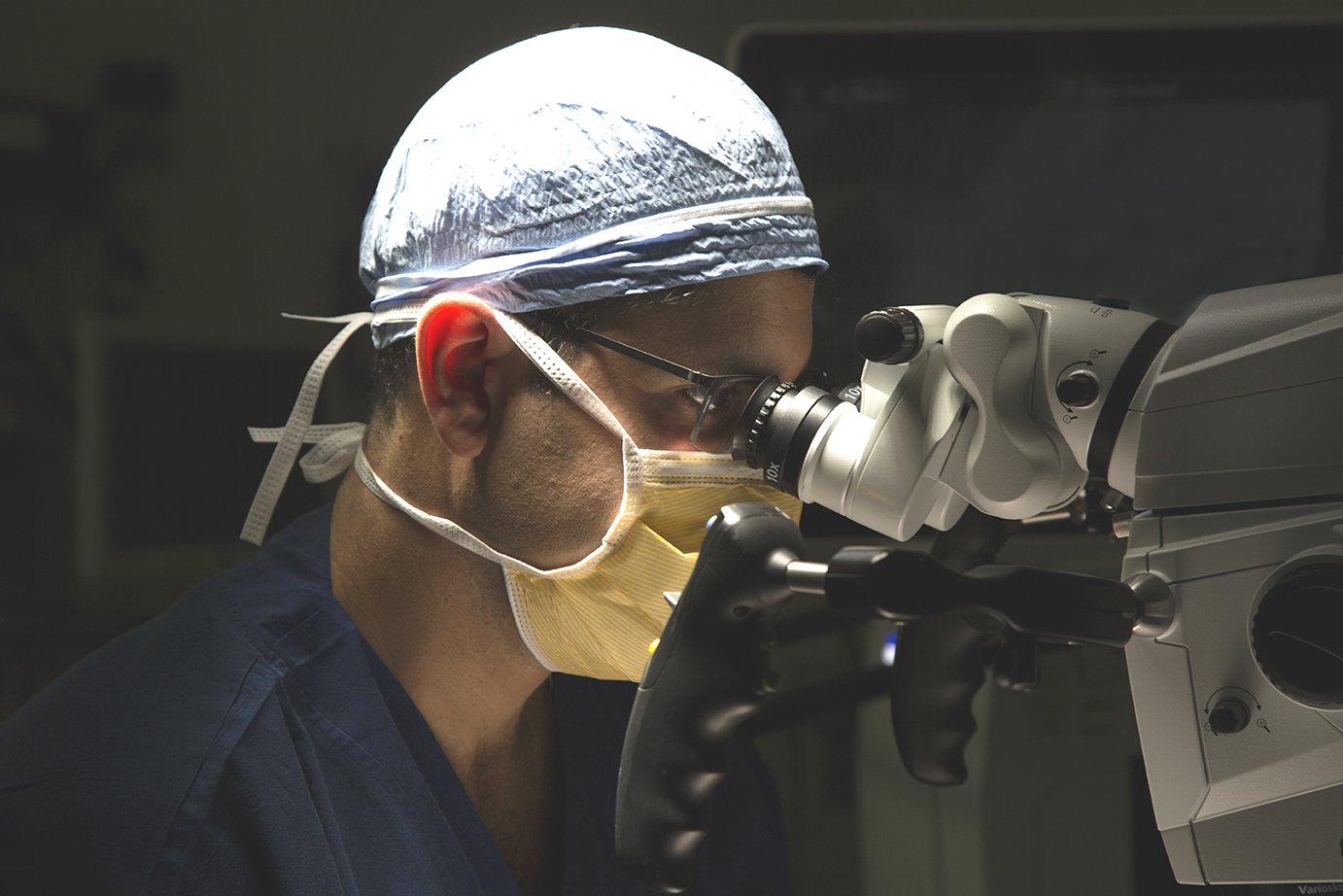
Microsurgery is a specialised surgical technique that uses an operating microscope and precision instruments to perform surgery on extremely small structures, typically blood vessels and nerves measuring in the order of 1-3 millimetres in diameter. This advanced technique allows surgeons to reconnect, repair, or reconstruct delicate tissues with exceptional precision.
In plastic and reconstructive surgery, microsurgery is essential for complex procedures that require transferring tissue from one part of the body to another while maintaining its blood supply. The free flap operation was initially performed in Melbourne in 1973, and there has been significant progress and developments since that time. Dr Haddad's training and experience in microsurgical techniques enables him to perform sophisticated reconstructive procedures that would not be possible using conventional surgical methods. These skills are adapted to other parts of his surgery, including delicate suturing at cosmetically sensitive sites on the face.
Microsurgical Procedures in Plastic Surgery
Breast Reconstruction
The most common microsurgical procedure Dr Haddad performs is DIEP flap breast reconstruction, where tissue from the abdomen is transferred to the chest to rebuild the breast after mastectomy. Using a microscope, blood vessels are reconnected from the transferred tissue to blood vessels in the chest, re-establishing blood flow to keep the tissue alive.
This procedure offers women reconstruction using their own tissue rather than implants, creating breasts that feel more natural, age with the body, and don't require replacement over time.
Complex Hand Surgery
Microsurgery plays a crucial role in treating severe hand injuries where tendons, nerves, or blood vessels have been damaged. This sphere encompasses replantation surgery, where amputated digits or limbs are reattached.
Nerve repair and reconstruction in the hand requires microsurgical expertise to align and suture the tiny nerve fibers, giving them the best opportunity to regenerate and restore feeling and movement.
Head and Neck Reconstruction
Dr Haddad performed major head neck reconstructive surgery at St Vincent’s for many years. He has been more focussed on skin cancer work in recent years and doing less major reconstruction. He supervised several publications in this space, including his approach to pharyngectomy reconstruction using a dual paddle microvascular transfer from the outer thigh. This series and approach presented outcomes with complication rates amongst the lowest in the world.
Limb reconstruction
Most microsurgical reconstruction in the limbs is performed in the context of major trauma, but occasionally after cancer resection. They are essentially limb saving surgeries. These injuries can be life changing in many regards. Surgery is complex and recovery and rehabilitation can be protracted. Careful decision making is required. Watching a patient’s recovery, and contribution to that journey, is amongst the most satisfying part of plastic surgery.
Understanding Microsurgical Risks
While microsurgical techniques have revolutionized reconstructive surgery, they carry specific risks:
Free flap failure: The most serious risk is loss of the transferred tissue if blood flow is compromised. This occurs in approximately 1-5% of cases despite meticulous technique. Early detection and immediate return to surgery can sometimes salvage the tissue, which is why close monitoring is important in the first days after surgery.
Vascular complications: Blood clots can form in the reconnected vessels, or the connections may develop technical problems requiring revision surgery.
Extended surgery time: Lengthy operations carry increased risks including deep vein thrombosis, though preventive measures are routinely taken.
Donor site morbidity: This refers to some damage to the site where the tissue was taken from. In these transfer operations, you are essentially “robbing Peter to pay Paul.” There can be some weakening, numbness, fluid collections, and sometimes contour deformities created at the donor site.
The complexity of microsurgery means overall complication rates are higher than simpler procedures, though Dr Haddad's specialized training and experience work to minimise these risks.
Request a Consultation
Lorem ipsum dolor sit amet, consectetur adipiscing elit, sed do eiusmod tempor incididunt ut labore et dolore magna aliqua. Dui faucibus in ornare quam. Lectus urna duis convallis convallis tellus id interdum velit laoreet.