

Skin Cancer Surgery
What is Skin Cancer Surgery?
Skin cancer surgery involves the removal of cancerous lesions from the skin, usually with a margin of healthy tissue to ensure complete removal. The associated defect is then repaired, sometimes using simple closure or more specific plastic surgical techniques. While the primary goal is always complete cancer removal, the approach taken during surgery significantly impacts your final result.
The term aesthetic skin cancer surgery encompasses the treatment of skin cancers being performed with a higher level of attention, especially in terms of planning, surgical execution and scar management. Dr Roger Haddad brings a plastic surgeon's expertise to skin cancer treatment, combining oncological precision with advanced reconstructive techniques. This dual focus ensures not only effective cancer removal but also optimal cosmetic outcomes, particularly important when treating visible areas such as the face, neck, and hands.
Unlike standard excisions that may prioritise speed and simplicity, a plastic surgical approach to skin cancer surgery employs meticulous closure techniques, careful planning of incision placement, and sophisticated reconstruction methods that minimise scarring and preserve natural contours.
What types of skin cancer does Dr Haddad treat?
Dr Haddad treats all types of skin cancers. By far the most common subtype is a basal cell carcinoma, which tends to be locally growing. Squamous cell carcinoma is the second most common subtype and this has capacity to metastasise usually to regional lymph nodes in the first instance. Again, this is a spectrum of disease with some lesions being low-grade and others potentially more aggressive and needing wider surgical margins and expeditious treatment. He also treats melanoma and melanoma in situ. Dr Haddad works in a tertiary centre being the St Vincents Campus where he liaises closely with other surgeons, dermatologists, pathologists, medical and radiation oncologists. This facilitates access to relevant investigations and expeditious referrals as needed.
Occasionally, skin cancers can be of a less common subtype or require more complex decision making. In these cases the opinions of a diverse group of medical specialists can be sought through a multidisciplinary meeting.
Dr Haddad has been a member of the St Vincents Genesiscare Skin and Melanoma Multidisciplinary Team (MDT) for several years and has a good understanding of different treatment options including emerging therapies.
He will be able to guide and advise on appropriate treatment approaches, which sometimes may not require surgery.
Further details can be found in the following references:
Clinical Practice Guidelines for the Diagnosis and Management of Melanoma
Clinical Practice Guidelines for the Diagnosis and Management of Melanoma, Cancer Council Australia © 2024; version 1.1, published on 5 April 2024.
ABOUT THE PROCEDURE
Dr Haddad’s Surgical Approach to Aesthetic Skin Cancer Surgery
The overriding goals in skin cancer surgery will usually entail:
Appropriate cancer clearance
Achieving skin healing
Optimising the aesthetic result.
Dr Haddad’s extensive experience in plastic surgery takes into consideration different skin and tissue types, as well as requirements at special locations.
Applying plastic surgical principles to skin cancer surgery helps improve results. This involves careful planning, appropriate procedure selection, gentle tissue handling, and appropriate anaesthesia to reduce operative bleeding. Medical management of blood thinners perioperatively also needs to be tailored to each patient depending on their associated risk factors. Other factors include local anaesthetic injection techniques, minimising thermal injury to the skin and tissues during surgery, appropriate selection of sutures and careful suturing. Dressings to protect the repair site and of course careful aftercare.
While skin cancer surgery sometime sounds simple, it can be done with a higher level of finesse and attention to attain better results. Perfect results are not always guaranteed and are dependent often on the size and location of the lesion, as well as skin and genetic patient characteristics which can be outside of our control
Pre-surgical Planning
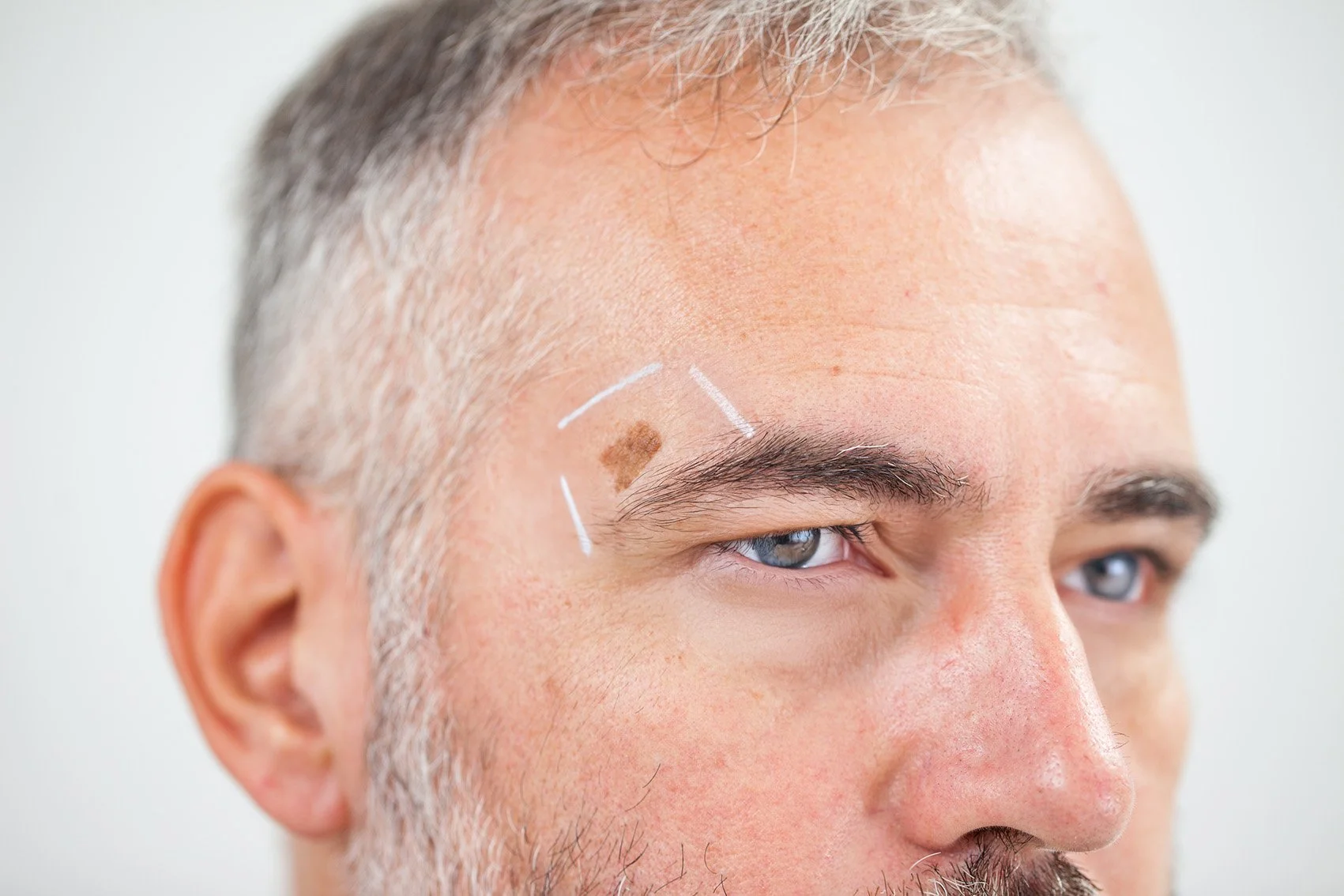
Pre-surgical planning begins with a thorough assessment of the lesion, the anticipated repair, as well as your individual skin quality and preferences. Dr Haddad carefully maps out incision lines that follow natural skin creases and tension lines where possible, helping scars blend more naturally with your skin's architecture.
Skin Cancer Excision
The excision is performed with appropriate margins as needed for complete cancer removal. This requires experience and judgement to determine the boundaries of the tumour, assess depth, and apply an appropriate margin. Dr Haddad operates using magnification and bright light to facilitate these markings. A similar marking is usually performed during your consultation to assist accurate planning and consider appropriate repair options, as well as your preferences.
Some lesions are more poorly demarcated and it can be difficult to judge the boundaries. Of course this can have implications for choice of repair. In this setting we may engage a pathologist to be present in the operating theatre, so that we can attain frozen sections from around the edges of the tumour. This increases our confidence of clearance before committing to a reconstruction. In some cases a two-stage approach, may be preferred, which will involve excision of a tumour in the first procedure. The wound is not repaired at this time, but temporised with a dressing while formal pathology is attained. A subsequent procedure is then required to repair the defect, usually a few days later, once formal confirmation of clearance is attained. The repair or reconstruction is performed at this second stage. This approach is called a slow Mohs technique. This is different to Mohs micrographic surgery which is a specific technique performed by some dermatology colleagues. Sometimes the latter approach is most favourable and Dr Haddad can provide guidance on this also.
Reconstruction & Closure
Reconstruction and closure is where plastic surgical training makes the most significant difference. Rather than simply pulling skin edges together, Dr Haddad may employ:
Direct closure using layered closure techniques that reduce tension on the skin surface, minimising scar widening.
Local Flap reconstruction where skin is carefully repositioned from adjacent areas to fill the defect while maintaining natural contours. Local flaps are often preferred as they replace “like with like,” using skin from the immediately adjacent area.
Skin grafts for larger defects, carefully matched where possible for colour and texture. A skin graft is detached from a suitable donor site on the body, and placed into the excision site. The skin is dependent on the recipient site for nutrition. We sometimes graft different tissues such as fat or cartilage if needed. Most skin grafts on the face and scalp involve full-thickness skin grafts. These can be taken from sites around the ears, or sometimes from the forehead, cheek fold, or base of the neck. For the legs we sometimes use split skin grafts, taking a shaving of skin from the outer thigh. Some patients are concerned about slow healing with skin grafts; “graft take” is usually very high if the surgery is performed thoroughly and appropriate after-care adhered to.
Complex reconstructive methods if required. These move a block of skin or tissue from a more distant site in the body, and transplanting that tissue to the defect. Dr Haddad is proficient in microsurgical procedure, but details are beyond the scope of this page.
Your Hospital Stay
Most skin cancer surgeries are performed as day procedures under an assisted local anaesthetic (sedation), allowing you to return home the same day. For more complex procedures or higher risk patients, post surgical hospital admission may be required.
Who is Aesthetic Skin Cancer Surgery For?
Ideal Candidates
This approach to skin cancer surgery is particularly valuable for patients who:
Have skin cancers on cosmetically sensitive areas such as the face, neck, décolletage, or hands
Are concerned about visible scarring and aesthetic outcomes
Have larger lesions that require more complex reconstruction
Have had previous skin cancer surgeries with suboptimal cosmetic results
Require tissue-sparing techniques to preserve function (such as around the eyes, nose, or mouth)
Want the combined expertise of oncological completeness and aesthetic refinement
Who May Not Be Suitable
While Dr Haddad's plastic surgical approach can benefit most patients, some situations may be more favourable for alternative management options.
A consultation with Dr Haddad will help determine the most appropriate treatment approach for your individual circumstances.
Your Recovery & Aftercare
Immediate Post-Operative Period
You'll leave with a dressing over the surgical site, which typically remains in place until your first follow-up visit. Some bruising and swelling around the area is normal and usually peaks within the first few days.
Pain management is usually straightforward, with most patients requiring only over-the-counter pain relief. Prescription pain medication may be provided for more extensive procedures.
First Week Post-Op
Sutures are typically removed between 4-14 days post-surgery, depending on the location. Facial sutures are often removed earlier (4-5 days) while those on the body or limbs may stay in place longer (7-14 days).
During this time, you'll need to:
Keep the dressings clean and dry as directed
Elevate the operated area
Avoid strenuous activity that might increase swelling or place tension on the wound
Take any antibiotics if prescribed
Attend follow-up appointments for wound checks and suture removal
Scar Maturation
Scars evolve significantly over time. Initially, scars may appear red or pink and slightly raised. Over the following 3-6 months, scars typically:
Fade from red/pink to a pale colour closer to your natural skin tone
Flatten and soften
Become less noticeable as they mature
Scars will generally continue to improve and settle over 12 months.
Scar Management Techniques
Dr Haddad may recommend include:
Taping for incision support and to prevent scar widening
Silicone-based scar treatments to minimise scar thickening
Sun protection to prevent pigmentation changes
Gentle massage once the wound has fully healed
Consideration of laser treatments for scar refinement if needed
Long-term Follow-up
Regular skin checks are essential following skin cancer treatment, as having one skin cancer increases your risk of developing others. Dr Haddad will usually advise continued surveillance with your dermatologist. Sometimes more frequent surveillance may be required and an appropriate schedule will be discussed if needed.
Surgical Complications & Risks
While Dr Haddad's meticulous surgical approach aims to minimises complications, all surgery carries some inherent risks:
General surgical risks include:
Bleeding or haematoma formation
Infection
Delayed wound healing
Adverse reactions to anaesthesia
Specific to skin cancer surgery:
Incomplete excision requiring further surgery (this is why clear margins are confirmed through pathology)
Wider scarring than anticipated, particularly if healing complications occur
Changes in skin sensation around the surgical site
Asymmetry, particularly when treating paired structures like ears
Skin graft or flap complications such as partial loss
Scarring considerations: While every effort is made to minimise scarring, individual healing varies. Factors affecting scar quality include your age, skin type, genetics, the location and size of the cancer, and how well you follow aftercare instructions.
Dr Haddad will discuss specific risks relevant to your procedure during your consultation.
Frequently Asked Questions
How visible will my scar be?
Scar visibility depends on several factors including the size and location of the cancer, your skin type, and individual healing. Dr Haddad's plastic surgical techniques are specifically designed to minimise scarring. Most facial scars fade considerably over 12 months and can often be concealed with makeup if desired.
Can you guarantee complete scar removal?
While complete scar elimination isn't possible, plastic surgical techniques can dramatically improve scar quality compared to standard excisions. The goal is to create the finest, least noticeable scar possible while ensuring complete cancer removal.
What if the cancer isn't completely removed in the first surgery?
If pathology shows positive margins (cancer cells at the edge of the removed tissue), further surgery or sometimes another treatment may be required. Dr Haddad will discuss the options.
How long until I can return to work?
This depends on the extent of surgery and your occupation. Many patients return to desk-based work within a few days. Physical jobs may require 1-2 weeks off. Dr Haddad will provide specific guidance based on your procedure.
Will I need a skin graft or flap?
Not all skin cancers require these techniques. Smaller lesions can often be closed directly with excellent results. Larger defects, or those in cosmetically challenging areas, may benefit from flap reconstruction or grafting to achieve optimal outcomes.
Can I have the surgery under local anaesthetic?
Many skin cancer excisions can be performed comfortably under local anaesthetic. More extensive procedures, or multiple lesions in one session, may be better suited to sedation or general anaesthetic. This will be discussed during your consultation.
How soon can I exercise after surgery?
Walking is encouraged from the next day, but strenuous exercise should be avoided for 2-4 weeks depending on the location and extent of surgery. Activities that increase blood pressure or place tension on the wound can compromise healing and potentially widen scars.
What sun protection will I need?
New scars and skin grafts should be protected from sun exposure for at least 12 months to prevent permanent pigmentation changes. Use SPF 50+ sunscreen and consider physical protection like a broad brimmed hat for facial scars.
NEXT STEPS
Request a Consultation
Early treatment of skin cancer usually offers the best outcomes, both for clearance and aesthetic outcome. If you've been diagnosed with a skin cancer, Dr Haddad can provide expert care that combines cancer treatment with attention to the cosmetic result.